

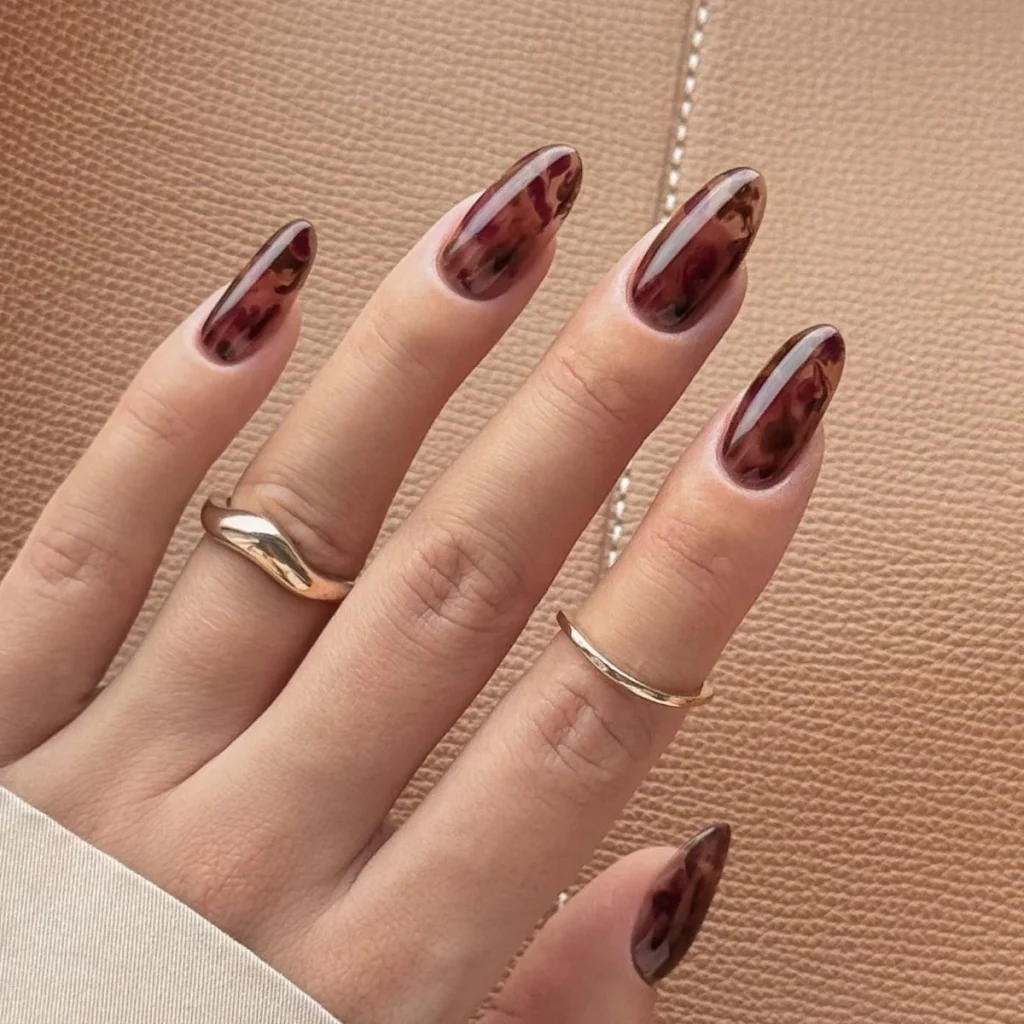
Creating modern tortoise shell nails patterns with Semilac UV Hybrid
Master tortoise shell nails with Semilac. Learn a fast transfer foil technique on a black base for gold-orange patches. No freehand painting required. See how!
Tortoise shell nails is one of those patterns that never fully leaves the nail trend cycle – it resurfaces every autumn and each time picks up a new edge. This version, built with Semilac UV Hybrid, uses transfer foil on a black base to create irregular orange-gold patches without freehand painting. This guide covers the technique, the product lineup, and how to balance the look across five nails. Here’s everything you need to know!
Here is what this guide covers:
- how foil transfer creates the tortoise shell nails effect without freehand painting
- which shades build the black-and-pumpkin base that anchors this look
- how to balance pattern nails with solid accents for a wearable statement manicure
The autumn tortoise shell nails look: foil, black, and pumpkin in one set
This stylization uses short rounded square nails. Three to four nails carry Perfect Black 300 as a solid deep gloss – the foundational dark that makes the accent nails read sharply. One nail uses Spicy Pumpkin 402, an intense rusty orange that sits between orange and brown. The final nail is the tortoise shell focal point: a black base with transfer foil in irregular orange and gold patches.
The foil transfer technique is what separates this look from painted animal prints. Apply a gel adhesive or an uncured gel layer, let it reach a tacky state, then press the foil sheet and peel quickly – the metallic pigment transfers in organic, irregular shapes that replicate the mottled quality of real tortoise shell far better than brushwork.
Warm foil tones against a black base
The orange and gold tones of the foil against the black base produce the classic warm-on-dark contrast that defines the pattern. For a different no-tape precision technique that pairs well with this kind of foil work, our stripes on gel nails without tape guide covers a complementary method.
Why does black anchor this pattern instead of brown?
Traditional tortoise shell uses dark brown as the base, but this modern version replaces brown with black for a bolder graphic read. Semilac Gel Nail Polish in Perfect Black 300 gives the darkest contrast against the orange and gold foil patches – the result feels more statement-forward, moving it from material replication into nail art territory. The full look, built with Semilac UV Hybrid, holds up well when base layers are properly cured.
Hybrid Polish in a deep black also cures to a very smooth, even surface, which matters for foil adhesion – any texture or bubbling in the base layer causes the foil to transfer unevenly. Cure Perfect Black 300 in two thin layers and ensure full cure before the adhesive step. A slightly thicker uncured gel layer under the foil produces larger, more defined patch transfers – useful when you want the tortoise shell shapes to read clearly rather than as fine scattered marks.
Balancing pattern and solid nails in a five-finger set
The 3-1-1 distribution – three black solids, one pumpkin solid, one foil tortoise – gives this look its balance. The foil nail carries all the pattern complexity, the pumpkin nail bridges the color connection, and the black nails provide graphic weight without competing for attention. This structure works because the eye has one focal point per hand rather than multiple accent nails pulling in different directions.
Why restraint reads as intentional design
Nail Art Gel Polish applications like this one benefit from restraint. Over-accenting a set with multiple patterned nails dilutes the impact of each. The single tortoise nail reads as intentional design rather than busy decoration. For clients who want more warmth, switching one black nail to Spicy Pumpkin 402 shifts the ratio without losing the structure.
Why foil tortoise shell nails keeps earning repeat bookings
Foil transfer turns the classic tortoise pattern into something graphic and contemporary, and the 3-1-1 distribution keeps it wearable. In our experience, this look is easier to execute than freehand animal print once the tack window is dialed in. We also recommend keeping a foil tester nail nearby on the table – browse our leopard print nails guide for related directions.