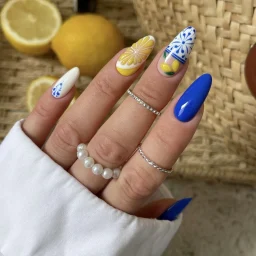
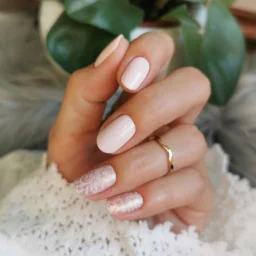
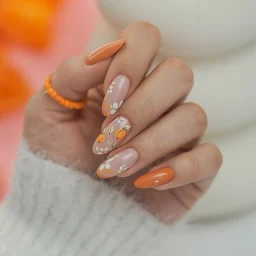
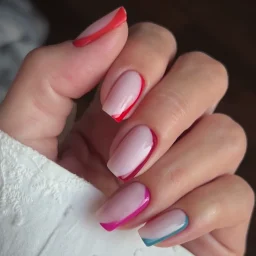
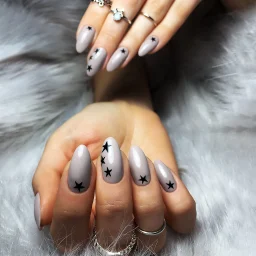
Four bristle shapes do almost all the work in nail art: liner, detail, flat and fan. A gnome, a snowflake and a soft pastel background painted over Semilac UV Hybrid color need three different brushes, not three different skill levels. Match types of nail brushes below to the mark it leaves on the nail!
What the brush shape decides:
- bristle length how far one stroke travels before you reload
- tip shape whether the mark ends in a point, an edge or a soft fade
- bristle care how long a brush keeps that shape at all
Why does the types of nail brushes shape decide how a design looks?
Among the types of nail brushes on a technician’s table, the tip sets both the width of a mark and the way it ends. Over a deep cobalt like Festive Blue 308, a thin white line reads sharp, and every wobble in it shows. Over a pale blue such as Blue Cloud 386, the same line sinks into the background and needs more pigment behind it.
Which types of nail brushes does what?
Most types of nail art brushes fall into four families, and each one owns a job the others do badly.
Liner and striper brushes
Long bristles carry enough product to pull one continuous line from the cuticle area to the free edge. A crisp white like Strong White 001 shows every hesitation in that stroke. Load product along the full length of the bristles before the stroke starts.
Detail and dotting brushes
Short bristles give up travel and buy control, which is the trade every small element needs. Dotting heads in our own kit come in 0.6 mm and 1.3 mm, and that gap decides whether the center of a snowflake reads as a dot or a blob. If a dot spreads after it lands, the head carried too much product.
Flat and angled brushes
A flat edge fills color fast and packs pigment into the sidewalls. An angled cut does the same along a smile line.
Fan and ombre brushes
Loose, spread bristles blur the border between two colors while the gel is still uncured. A soft pastel like Pastel Pink Sky 385 fades into white with far less tapping than a saturated shade.
Which types of nail brushes suits the design you want?
Work backwards from the picture: nail art brushes and their uses line up with elements on the nail, not with skill levels. The textured nail alongside the gnome and snowflake came from acrylic powder, placed rather than painted.
A six-arm snowflake repeats one long stroke six times. The tip, not the hand, keeps the arms matched. One arm out of line reads as a mistake across the whole nail. Frosted shades from our Winter Wonderland collection give those thin lines a background to sit on.
Brushes for painted characters
A painted gnome asks for three sizes of mark on one nail, which is work for a short detail brush with a point that holds. The red of the hat sits cleanest in a full-coverage shade such as Spiced Apple 305. Black Diamond 031 is pigmented enough to ask for thin layers and a longer cure, and a black outline over white tells you at once whether the brush and the hand are ready for fine detail.
Brushes for ombre and gradients
Gradients want a fan or a soft flat brush and a light, repeated touch. Pressure pushes pigment around instead of blending it.
Natural or synthetic bristles for gel products?
Synthetic bristles hold their shape in the thicker mediums used with Semilac UV Hybrid color and release product cleanly. Natural hair swells in gel and loses its point within a few sets. Synthetic is the safer buy for anyone painting in gel every day.
How do you clean nail brushes so they keep their shape?
Wipe the brush while the product is still soft: gel left in the bristles cures under room light and sets that shape for good.
What decides how to clean nail brushes without wrecking them:
- timing wipe before the product has a chance to cure in the belly of the brush
- direction pull from the ferrule to the tip on a lint-free wipe, never scrub sideways
- shape reform the point with your fingers while the bristles are still damp
How do you store brushes between appointments?
Keep them capped, lying flat or standing bristles up, away from the lamp and direct daylight. Residue in the hairs keeps curing on the shelf. Standing them in a jar works as long as nothing leans against the hairs.
Types of nail brushes that pay for themselves
A neutral like Business Line Official Grey 224 shows the difference fastest: a flat, streak-free field of Semilac Hybrid Nail Polish depends on the brush more than on the number of coats. In our experience, a brush that holds its shape saves rework across the whole set.
Frequently asked questions about types of nail brushes
How many brushes do I really need to start?
Three cover almost every request: a fine liner, a short detail brush and a small flat brush.
Why does my liner brush leave uneven lines?
The product is usually too thick, or the brush was reloaded halfway through the line instead of before it.
Can I use the same brush for gel and acrylic?
Keep two separate sets: monomer and gel leave different residues in the hairs, and no point survives that mix.
What do I clean gel brushes with?
Use the cleaner named on the product you are painting with; acetone belongs to removal, not to brush care.
How often should brushes be replaced?
Replace one when the tip stops reforming after cleaning, rather than on a set schedule.