How to Apply Rhinestones and Crystals for Lasting Semilac Nail Art
Learn how to apply rhinestones and crystals that stay on for weeks! Master the best adhesion and sealing techniques for durable Semilac nail art designs.
Rhinestones and crystals can make a manicure unforgettable – or fall off by day two if the application isn’t right. In this guide, we cover the placement techniques, adhesion methods, and sealing steps that keep embellishments locked in place through the full wear. Stick around for the details!
Here is what this guide covers:
- which adhesion method gives the longest-lasting rhinestone hold
- how to place crystals for a clean, professional finish
- how to seal embellishments without dulling their sparkle
Why do rhinestones fall off so quickly?
The most common reason rhinestones lift is placement onto an insufficiently tacky surface. Apply Rhinestones and Crystals onto a fully cured, wiped top coat gives the adhesive almost nothing to grip – the smooth, sealed surface repels rather than holds. The correct base for rhinestone placement is either a no-wipe gel top coat left uncured, or a dedicated nail art gel applied specifically as an adhesive layer. Curing after placement – rather than before – is what locks the embellishment into the gel matrix rather than sitting on top of it.
Flat-back crystals with a larger surface area bond more reliably than round-base stones because more of the base makes contact with the adhesive layer. Size matters too – larger stones carry more weight and need a thicker adhesive base to compensate.
How to apply rhinestones and crystals cleanly and precisely
A wax-tipped dotting tool or a rhinestone picker pen picks up individual crystals without shifting their position mid-transfer. Tweezers work for larger stones but introduce rotation during placement that throws off alignment, especially in tight geometric patterns. Pressing each stone down with gentle, even pressure immediately after placing – rather than nudging it into position – keeps the base flat against the nail and prevents air pockets under the stone that cause premature lifting. Crystal embellishments work particularly well over detailed nail art bases – our highlight nail art guide and vintage nails collection show how different base styles interact with stones.
Placement order for multi-stone designs
Working from the center outward keeps spacing consistent and prevents the first stones from shifting as subsequent ones are added nearby. Curing in short intervals during a complex design – rather than at the end – locks earlier placements before later ones disturb them.
The correct placement sequence for a multi-stone design:
- Apply adhesive gel layer and leave uncured
- Place the center stone first and press down with even pressure
- Work outward in both directions, placing stones symmetrically
- Cure after every third or fourth stone to lock placements
- Apply sealing gel around each stone base before the final cure
The base shades that make crystals shine hardest:
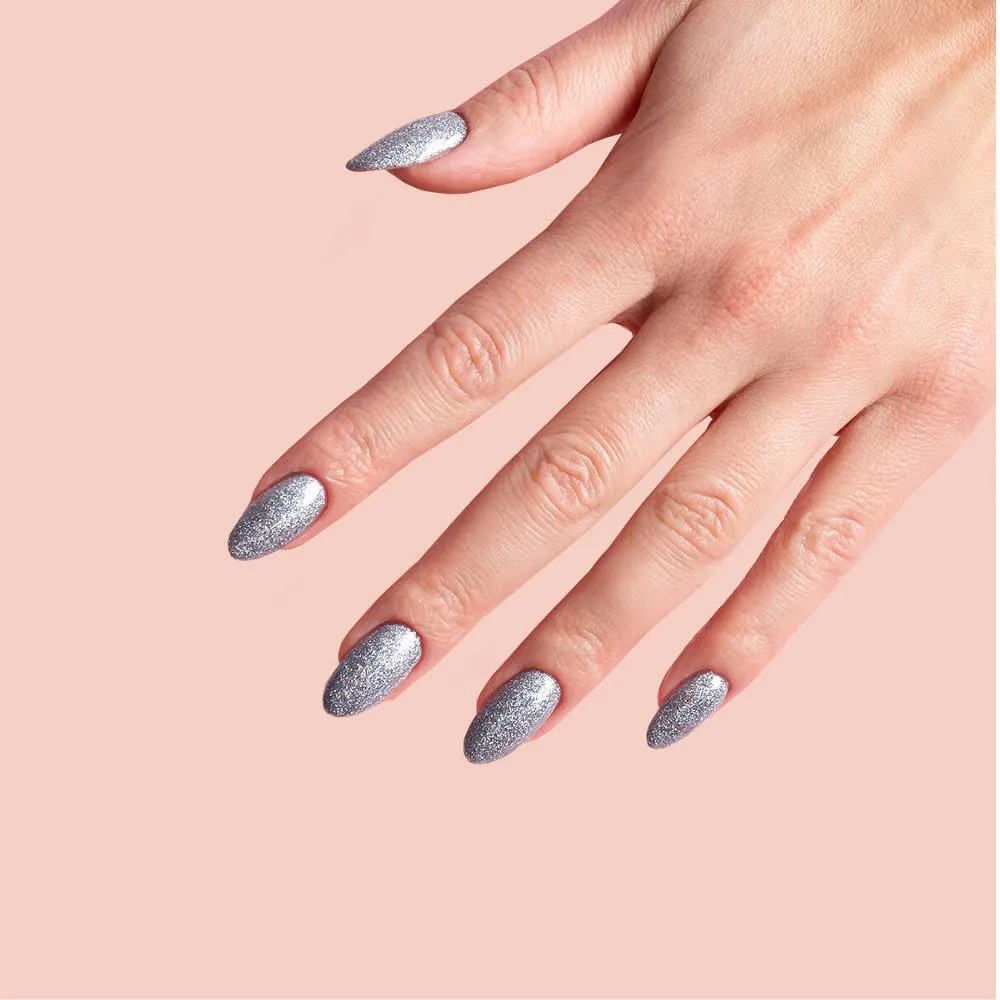
- Hollywood Silver 461 – a metallic base that amplifies crystal reflection
- Deep blacks and navies – high contrast makes every stone read as a point of light
- Sheer nudes – understated base lets the embellishment carry the full design
- Gel top coat left uncured – the stickiest, most reliable adhesion surface for any stone size
How to apply rhinestones and crystals without killing the sparkle
Flooding a rhinestone with top coat kills its faceted reflection – the gel fills the cuts that catch light and turns a sparkling crystal into a dull dome. The correct technique is to apply top coat around the stone rather than over it, building a wall of gel against the base on all sides. For larger stones, a fine brush with a small amount of gel along the joint between stone and nail creates a mechanical seal that holds without covering the stone face – keeping the sparkle fully intact through the entire wear.