

Heat spikes
Stop the burning sensation! Learn what causes heat spikes during curing and how to ensure maximum comfort for your clients with every Semilac service.
Here is what this guide covers:
- why heat spikes happen and what triggers them
- how layer thickness directly affects curing temperature
- what to do when a client feels discomfort mid-cure
Why do heat spikes happen during curing?
Every gel cure generates some heat – that’s just chemistry. The photoinitiators in the formula react with UV light and release energy, and that energy shows up as warmth at the nail surface. The thicker the layer, the more photoinitiators reacting at once – and the more heat the nail plate has to absorb. Clients with damaged, over-filed, or naturally thin nails feel this most, and they’ll often signal it by the second or third coat if you’re applying too generously.
The lamp matters as much as the product. High-powered LED lamps cure faster but concentrate that heat into a shorter window, which is exactly when clients flinch. Dropping wattage or switching to a pulse-cure setting delivers the same full cure with noticeably less thermal intensity – and most clients never even notice the difference in cure time.
How application technique reduces heat spikes
Of everything that affects curing comfort, layer thickness is the one thing entirely in your hands. A layer that looks slightly translucent when applied cures cooler than one that looks fully opaque – the pigment load is lower, the reaction is slower, and the heat spreads more evenly across the nail. Building color in three thin coats rather than two generous ones adds thirty seconds to the service but can be the difference between a comfortable appointment and a client who doesn’t rebook.
Keeping the brush parallel to the nail rather than pressing into it controls how much product pools in any single area. Uneven thickness near the cuticle or sidewalls creates hot spots in exactly the spots where the nail plate is thinnest – and where clients feel it most.
The shades where curing comfort matters most:
- Icy Waterfall 240 – flash effect formula, apply in extra-thin layers for even cure
- Ocean Flower 241 – rich pigmentation builds fast, so thin coats matter more than usual
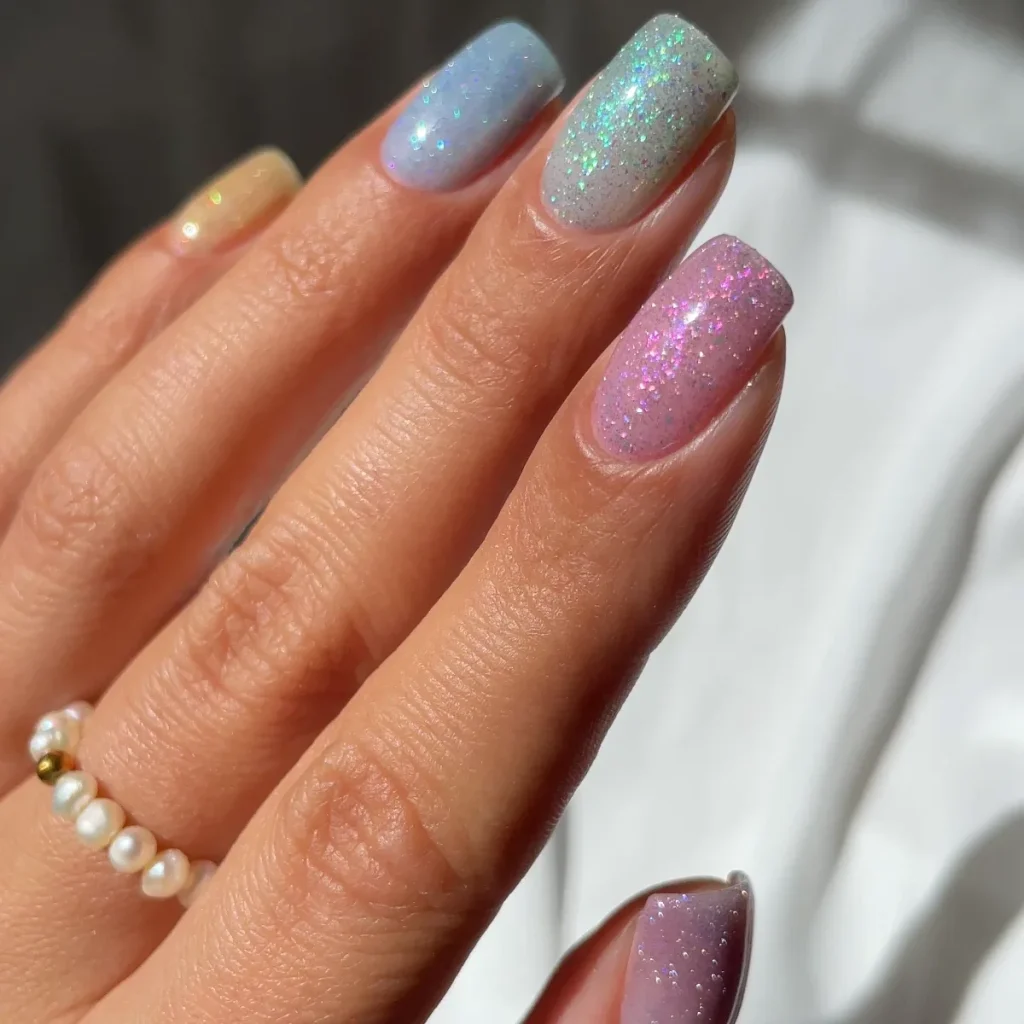
- Pink Sands 242 – shimmer particles create uneven thickness if applied too heavily
- Any highly pigmented shade – full-coverage colors tempt over-application, which is where heat spikes start
What to do when a client feels burning mid-cure
Quick reference for reducing heat spikes during a service:
- Switch to pulse-cure mode if the lamp supports it – same cure, lower thermal intensity
- Re-cure in two short bursts rather than one full cycle when a client signals discomfort
- Place a folded paper towel under the lamp to slightly increase the distance between nail and bulb – less intensity, same cure
When a client says it burns – stop. Pull the hand out, let the heat go, and re-cure in shorter intervals. Pushing through discomfort isn’t toughness, it’s a thermal injury risk – and a fast way to lose a client’s trust permanently. Most lamps let you interrupt mid-cycle. The glass nails guide covers layering techniques that keep individual layers naturally thin – the same principle that prevents heat spikes from starting in the first place.