Achieving the Perfect light line: Photo-ready finishing with Semilac Nail Polish
Master the perfect light line on your nails. Learn how to build a photo-ready finish with Semilac top coats and avoid errors that ruin your shots.
The perfect light line – that bright, curved highlight running across the apex of the nail – is what separates a flat-looking manicure from one that photographs beautifully. Semilac Nail Polish gives you the pigment and top coat clarity to build it deliberately, not by accident. This guide breaks down what the light line actually is, how to construct it through proper finishing, and which mistakes collapse it before your client even picks up her phone for a selfie!
Here is what this guide covers:
- what the perfect light line is and why it shows up (or disappears) in photos
- how to build the apex shape and gloss layer that create a lasting highlight
- which common mistakes destroy the effect – and how to avoid them
What is the “perfect light line” and why does it matter for photos?
A perfect light line is the bright reflection that forms along the highest point of a convex nail shape. When a nail has a well-defined apex – the slightly raised ridge running from sidewall to sidewall across the midpoint – the surface curves away from the light source on both sides. That curvature concentrates the reflection into a single, clean band. Flat nails scatter light evenly and produce no visible highlight. The difference is immediately obvious in any photo.
For clients who post to Instagram or TikTok, the light line is what makes a nail look three-dimensional on screen. A Hybrid Polish finish with high gloss brings the reflection into sharp focus. Our ultimate clean girl look guide pairs this photo-ready finish with the minimal nude palette that dominates current social feeds. Most technicians find that clients notice this detail in side-by-side reference shots and ask for it by name.
How to build the light line through proper finishing
The light line is built in two stages: shape first, then surface. Shape comes from your Gel UV Hybrid layer. Apply in two thin coats, pressing lightly at the sidewalls and building height at the plate’s center. The apex should be the highest point – roughly one-third from the cuticle toward the free edge. Two thin coats with a 30-second full cure between them give more control over height than one thick coat that flattens as it self-levels.
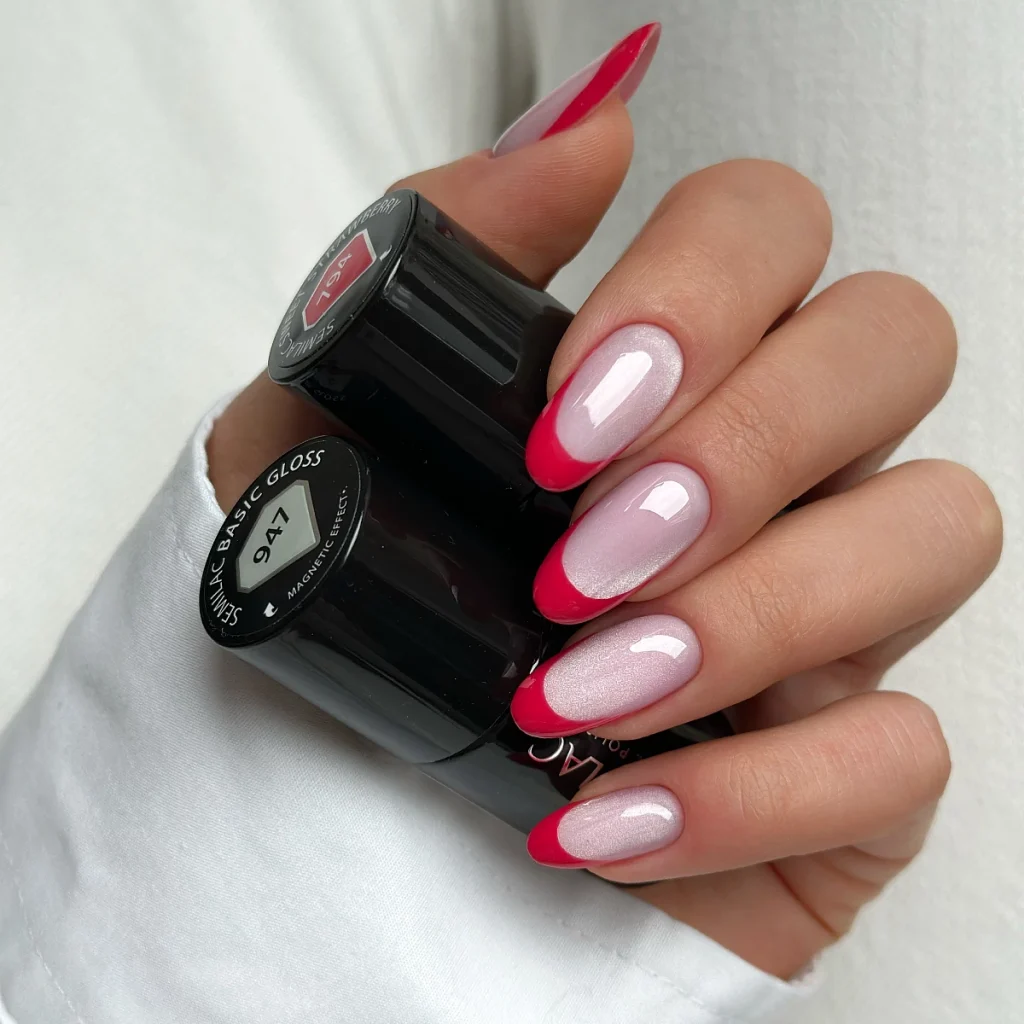
Surface comes from the top coat. A high-gloss no-wipe top is non-negotiable for photo-ready results. The glossy layer acts as a lens, amplifying the curvature beneath. For sheer and rosy shades, Basic Gloss 947 delivers a clean, neutral finish. For warmer berry tones, pair a mirror-gloss top over a saturated base like Sweet Strawberry – the light line reads as a bright streak against rich color.
The top coat shades that work best for photo-ready light lines:
- Basic Gloss 947 – neutral sheer tone lets the convex shape define the highlight without color distortion
- Sweet Strawberry 794 – warm berry base creates strong contrast between the lit apex and the shadowed sidewalls
- Photo-Ready Gel Nails across our Semilac collection – any shade with clean, true-tone pigment produces a sharper reflection than tinted or shimmer-heavy formulas
Common mistakes that break the perfect light line
The most frequent issue is under-curing. A top coat that hasn’t fully cured stays slightly soft on the surface – it looks glossy under salon light but develops micro-texture as it continues to cure in ambient conditions. That texture diffuses the reflection and softens the light line. Cure the top coat for the full 60 seconds in a 36W+ LED lamp every time, even when the surface looks set at 30 seconds.
The second common problem is contaminated top coat. A brush dragged back into a bottle after touching a dusty nail plate carries debris into the formula. Over time, even clear tops become slightly hazy. From hands-on work with our Semilac line, a contaminated top coat is one of the leading causes of dull, photographically flat finishes that clients can’t identify but immediately notice. Keep the bottle brush wiped clean on the rim and cap tightly between uses.
Correcting flat apex construction
Flat apex is the third issue. If the gel layer sits evenly across the plate with no dome, the surface reflects light across its whole area rather than concentrating it at the peak. The fix: during the second coat, pull slightly less product to the sidewalls and let the center stay fractionally thicker. Even a 0.3 mm arc reads as a defined light line on camera.
Semilac Nail Polish paired with deliberate apex work turns ordinary finishing into Photo-Ready Gel Nails that hold up across lighting conditions.
Why the perfect light line defines a photographed manicure
The light line is the small detail that separates a flat manicure from a photographically alive one – shape it deliberately, finish it cleanly, and it will hold across every camera angle. For more on clean finish work, check our professional nail prep guide.